AI vs Traditional Video Production: What to Expect
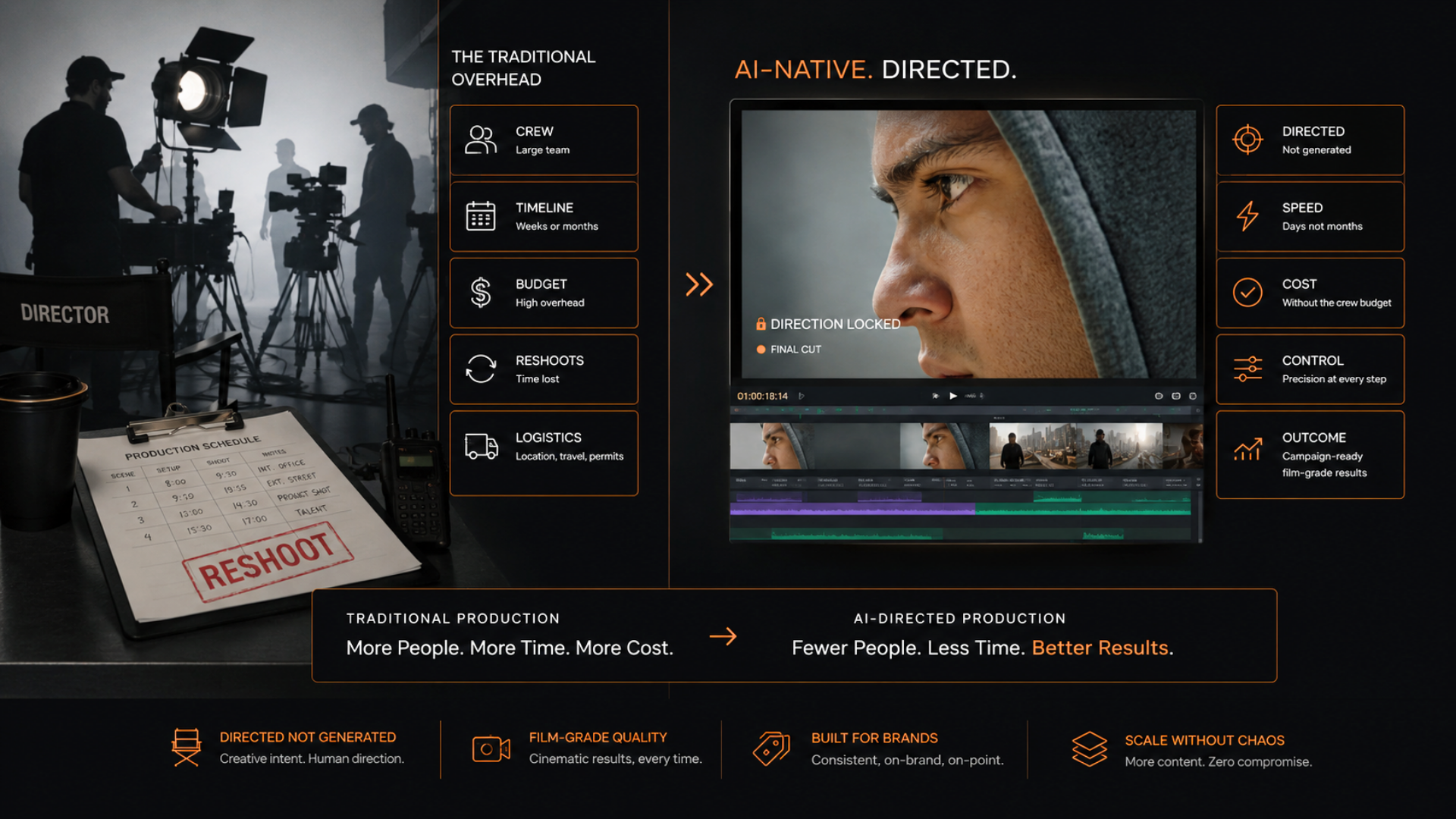
If you're weighing an AI-native video against a traditional shoot, the honest answer is that they aren't the same job at a different price. They change what you get, how fast, and where the risk sits. Here's a straight comparison, from a studio that works AI-native every day.
What a traditional shoot gives you
A traditional production buys you a crew, a camera, real locations, and real performers. For the right brief, that's exactly right, and nothing here argues otherwise. What it also buys you is a timeline measured in weeks or months, a budget with a five-figure floor before anyone presses record, and a long list of things that can go wrong on the day: weather, availability, reshoots, a location that falls through. You're paying for craft, and you're paying for everyone standing on set while it happens.
What AI-native production changes
AI-native production keeps the craft and removes most of the overhead. There's no crew to book, no location to hire, no day rates stacking up. A piece that would have taken a month comes back in days, at a fraction of the cost, and a change that would have meant a reshoot is just another pass. For a brand that needs a campaign to move quickly, or an artist who can't justify a film crew for a single release, that shift is the whole point.
The flexibility matters as much as the speed. The same hero film cut for six channels, or a brand avatar that stays consistent across a year of content, is straightforward when the work isn't tied to one day of filming.
Where AI still needs a human
Here's the part most of the hype skips. AI does not direct itself. Left alone, it produces the thing everyone's seen: a face that drifts between shots, a hand with too many fingers, a performance that floats half a second off the beat. That's the reason so much AI video looks cheap, and the reason serious buyers have stayed wary of it.
The difference between work that sells and work that gets scrolled past is direction: deciding the concept, holding a face and a world consistent, controlling the detail, and cutting anything that gives the method away. The AI is how it's made fast and affordable. The direction is why it doesn't look it. If anyone tells you the tool does it all, the result will show.
Which one is right for you
If your brief genuinely needs real people, real places, and the texture of a physical shoot, and the budget and timeline are there, a traditional production earns its cost. For most brand campaigns, product films, social content, and music videos, where the goal is a finished piece that looks funded and lands fast, AI-native is the better trade: the cinematic result, without the cinematic budget or the wait.
The mistake is choosing AI to save money and accepting work that looks like it. Choose it for the speed and the cost, but make sure it's directed, not just generated.
Thinking about a project?
That's the work we do: cinematic advertising and music videos, built AI-native and directed to hold up next to anything shot traditionally. Tell us about your project and we'll come back with a direction and a quote.