How Much Does AI Video Cost?
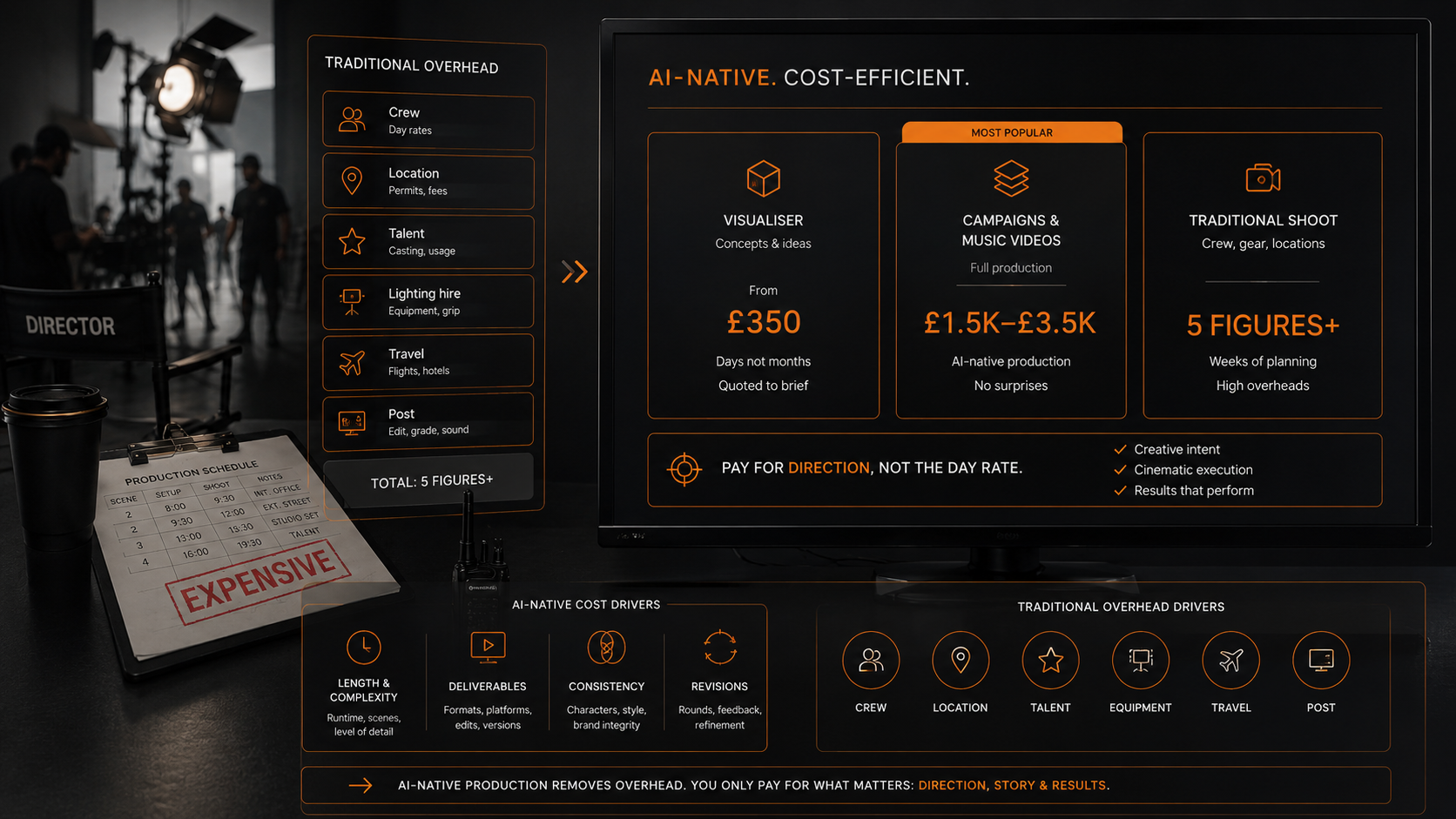
"How much?" is usually the first real question, and most studios dodge it. Here's a straight answer: what AI video actually costs, what moves the number, and how it compares to the traditional alternative.
The short version
AI-native video sits well below a traditional shoot. A single visualiser can start from around £350. Most campaign and music-video projects land between £1,500 and £3,500, with larger or multi-asset work quoted to the brief. A comparable traditional production, with a crew, a location, and a cast, rarely starts under five figures. The gap isn't a discount on quality. It's the cost of the crew, the kit, and the day on set that AI-native production removes.
What actually drives the price
Scope is the main lever. A few things move the number:
Length and complexity. A fifteen-second product ad is not a three-minute narrative film. More scenes, characters, and locations mean more direction and more production.
Number of deliverables. One hero film costs less than a hero film plus six social cutdowns, a set of stills, and vertical edits. A full asset set costs more in total, but far less per asset.
Consistency demands. Holding one artist or one product look steady across a whole piece takes more craft than a loose montage. It's also the part that makes the work usable.
Revisions and direction time. Most of this is agreed up front, which keeps it predictable. Briefs that shift mid-production are what stretch both time and cost.
Why it's cheaper than a traditional shoot
A traditional production pays for everyone and everything on set: crew day rates, camera and lighting hire, location fees, talent, travel, and the post that follows. AI-native production removes most of that overhead and compresses the timeline from months to days. You're paying for direction and craft, not for a room full of people while it happens. That's why the floor is so much lower.
Where the money should go
A warning worth giving: the cheapest AI video is cheap for a reason, and it shows. The difference between work that sells and work that reads as obvious AI is direction, the part that holds faces consistent, controls detail, and cuts anything that gives the method away. Spend on the direction, not just the generation. A well-directed piece at £1,500 will do more for you than a generated one at £300 that a viewer clocks as AI in the first three seconds.
Getting a real number
Every project is quoted to its brief, so the honest way to get your number is to describe what you need. Tell us the goal, the length, and how many versions you want, and we'll come back with a clear quote before anything starts. No surprises, no day rates ticking in the background.